

When you sleep next to your phone, your body encounters three primary effects: exposure to electromagnetic field (EMF) radiation throughout the night, disruption of your natural sleep-wake cycle from blue light and notifications, and measurable changes in sleep architecture that reduce deep sleep phases. According to a Pew Research Center survey, 65% of smartphone users keep their phones on or near their beds while sleeping, with that number reaching 90% among teenagers. This creates a nightly pattern that influences both immediate rest quality and long-term wellness outcomes.
The Quick Answer: Three Direct Impacts on Your Body
Understanding what happens when you sleep next to your phone starts with recognizing the immediate physiological responses. Your body doesn't simply "tune out" the device just because you've closed your eyes. The proximity creates ongoing interactions with your biology that continue for the full duration of your sleep. You can learn more about how phones affect your health at night to understand the full scope of these interactions.
1. Thermal and Cellular Stress Response: Your body may experience mild thermal effects from prolonged RF energy absorption, particularly if the phone is actively transmitting data while you rest. This can interfere with the natural drop in core body temperature needed for deep sleep.
2. Electromagnetic Field Exposure: Phones emit EMF radiation even in standby mode, and the intensity increases significantly during charging cycles. For those concerned about cell phone charging overnight, this continuous exposure pattern matters because it represents a full night of cumulative contact with electromagnetic fields.
3. Cognitive Activation from Proximity: Research published in the Journal of the Association for Consumer Research (2017) found that the mere presence of a smartphone reduces available cognitive capacity, even when the device is face down or powered off. During sleep, this "alert expectancy" can keep cortisol levels slightly elevated compared to sleeping in a phone-free environment.

These three factors work together throughout the night. They create a measurable difference in how rested you feel upon waking, even when you don't consciously recall waking up during the night.
EMF Radiation Exposure Patterns During Eight-Hour Sleep Cycles
Many people assume their phone emits the same amount of radiation regardless of how it's being used. The reality is more complex. Your phone's electromagnetic output varies dramatically based on its state, which directly affects your overnight exposure levels.
When a phone is actively charging, it typically draws more power and communicates with nearby cell towers more frequently. This increases the EMF output compared to a phone that's simply sitting on your nightstand. The charging process itself creates an electromagnetic field, and when combined with the phone's regular transmission pulses, the cumulative exposure becomes substantial.
A study published in the Journal of Biomedical Physics and Engineering (2025) investigated the influence of mobile phone-emitted RF-EMFs on sleep. While the researchers found no statistically significant difference in overall sleep quality between sleeping with and without a mobile phone, they did find that RF-EMF exposure had a notable impact on minimum and average blood oxygen saturation levels, suggesting physiological effects that sleepers may not consciously perceive.
| Phone State | Approximate EMF Output Level | Primary Radiation Type | Exposure Duration (8hr sleep) |
|---|---|---|---|
| Active Charging | High (Peak transmission) | RF + ELF + Thermal | Continuous 8 hours |
| Standby Mode | Moderate (Periodic pulses) | RF (intermittent) | Intermittent 8 hours |
| Airplane Mode | Very Low (Minimal emission) | Residual electronic | Minimal 8 hours |
| Powered Off | None | None | Zero exposure |
The data suggests that charging increases your exposure considerably compared to standby mode. This is significant because many people plug their phones in overnight to ensure a full battery by morning.
How Nighttime Phone Proximity Alters Melatonin Production
Your body's melatonin production follows a predictable pattern that starts in the evening and peaks during the middle of your sleep cycle. This hormone regulates your circadian rhythm and signals to every cell in your body that it's time for restorative rest. For those focused on optimizing their sleep environment, understanding melatonin biology is essential.
The issue isn't just about checking your phone before bed. Even the small amount of light that leaks from a screen or notification LED can interfere with melatonin synthesis. Your retina contains specialized cells called intrinsically photosensitive retinal ganglion cells (ipRGCs) that detect blue light wavelengths and send signals to the suprachiasmatic nucleus in your brain. When these signals arrive during darkness hours, they suppress melatonin production and shift your circadian phase later.
Smartphone sleep disruption extends beyond light effects. Notification sounds and vibrations, even when set to "do not disturb," can create micro-arousals that fragment your sleep architecture. Each time you hear or feel your phone, your brain briefly registers the alert and may spike cortisol production. Over eight hours, these small interruptions accumulate into meaningful sleep quality reduction.
Harvard Medical School researchers found that blue light suppresses melatonin for about twice as long as green light of comparable brightness, and shifts circadian rhythms by twice as much. A 2026 study in Scientific Reports further confirmed that even low irradiances of blue-wavelength light from common household and device sources can meaningfully disrupt melatonin secretion, measured using Melatonin Suppression Value (MSV) calculations across 52 different lamp types.
The combination of light exposure and anticipatory alertness creates a doubly harmful effect on your sleep quality. Addressing both factors is necessary for meaningful improvement.
Sleep Architecture Changes: What Happens to Your REM and Deep Sleep
Sleep isn't a uniform state. It's a series of cycles that move through distinct stages, each serving different restorative functions. When researchers study the relationship between sleep quality and daily habits, they look at how these stages are preserved or disrupted. Phone proximity during sleep appears to interfere with several key stages.
Deep sleep, also known as slow-wave sleep, typically occurs in the first half of the night. This stage is crucial for physical restoration, immune function, and tissue repair. Research from Frontiers in Public Health (2024) used a randomized, double-blind, placebo-controlled crossover design and found that sleep quality was significantly reduced during RF-EMF exposure compared to sham-exposure, with measurable changes in EEG power density across multiple frequency bands during non-REM sleep.
An earlier study by Loughran et al. (published in Bioelectromagnetics) exposed subjects to pulsed RF-EMF emitted by an actual mobile phone prior to a full night of sleep and found a decrease in REM sleep latency and increased EEG spectral power in the 11.5-12.25 Hz frequency band range during the initial part of sleep.
It's important to note: the science on EMF and sleep is still evolving. The large COSMOS cohort study (21,049 participants, published in Environment International, 2020) found that after adjusting for network type, the association between heavy mobile phone use and insomnia was likely due to behavioral factors rather than RF-EMF itself.
Sleep Latency: The time it takes to fall asleep increases by measurable amounts when phone-related stimulation occurs within 30 minutes of bedtime.
Slow-Wave Sleep Duration: Deep sleep phases may be shortened or more fragmented in the presence of active RF-EMF sources throughout the night.
REM Density: Rapid eye movement sleep, crucial for cognitive processing and emotional regulation, shows altered patterns in some RF-EMF exposure studies.
Sleep Efficiency: The percentage of time spent asleep while in bed drops when phones remain active in the sleep environment, though behavioral factors may account for much of this effect.
How to Keep Your Phone Nearby While Protecting Sleep Quality
For many people, the phone serves essential functions overnight. It's an alarm clock, a security device, and sometimes a connection to family members. Complete elimination isn't practical or necessary.
Enable Airplane Mode: This single step dramatically reduces radiation output while maintaining your alarm functionality.
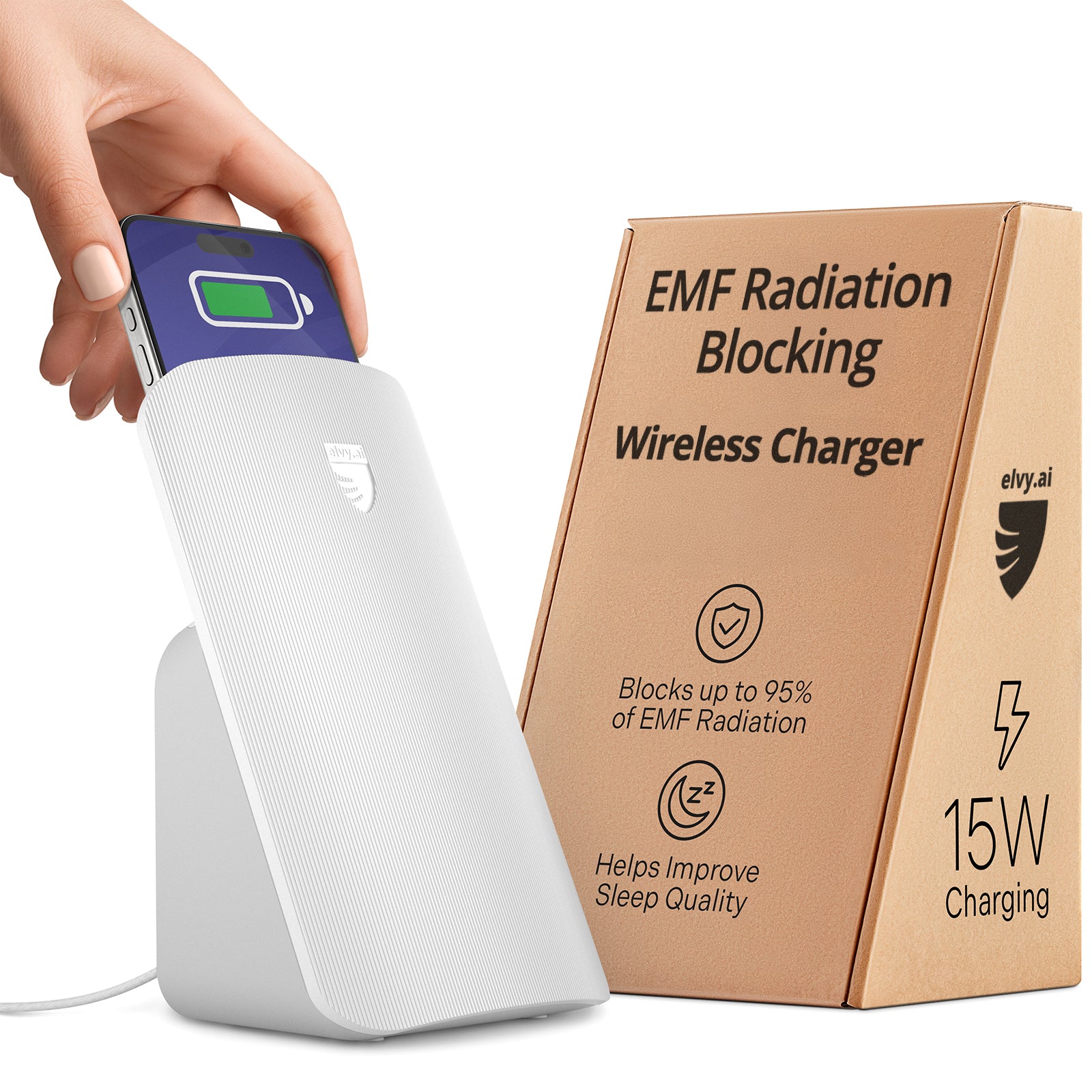
Use EMF-Blocking Accessories: Products like the Elvy Charger are designed to block up to 95% of EMF radiation while charging.
Position the Phone Correctly: Place your phone screen-down or face-away to minimize light leakage.
Establish a "Phone Parking" Zone: Designate a specific spot on your nightstand or across the room where the phone lives overnight.
Batch Notifications: Set your phone to deliver all non-urgent notifications at a specific morning time.
Distance Matters: The Three-Foot Rule and Why It Works
The inverse-square law states that the intensity of radiation decreases proportionally to the square of the distance from the source. Doubling your distance from your phone reduces your exposure by approximately 75%.
| Distance from Phone | Relative EMF Exposure | Reduction from Baseline |
|---|---|---|
| 1 foot (typical nightstand) | 100% (baseline) | 0% |
| 3 feet (across bed) | ~11% | 89% |
| 6 feet (across room) | ~2.8% | 97.2% |
Moving your phone from your pillow to a nightstand three feet away eliminates nearly 90% of your overnight EMF burden.
Key Takeaways: Making Peace with Your Phone at Bedtime
The research picture on what happens when you sleep next to your phone is nuanced. Some effects, like blue light's suppression of melatonin and the cognitive activation caused by phone proximity, are well-established. Others, like the direct impact of RF-EMF on sleep architecture, are supported by promising but still-evolving evidence.
Distance is your most powerful tool. The three-foot rule eliminates roughly 90% of EMF exposure without requiring you to change settings.
Airplane mode stops periodic transmissions while preserving alarm functionality.
Blocking technology like the Elvy Charger provides a practical solution for those who prefer to keep their phone charging within reach overnight.
Frequently Asked Questions About Sleeping Near Your Phone
Is it dangerous to sleep with my phone charging next to my head?
The evidence suggests caution is warranted. EMF exposure is highest during charging cycles. Use airplane mode or distance to mitigate exposure concerns.
Does airplane mode stop all radiation from my phone?
Nearly all, yes. Airplane mode disables cellular, Wi-Fi, and Bluetooth transmissions, eliminating roughly 99% of RF radiation.
How far away should my phone be when I sleep?
At least three feet for meaningful reduction. EMF exposure is reduced by about 89% at this distance.
Will my alarm still work in airplane mode?
Yes, absolutely. Your phone's alarm function operates independently of network connections.
Can I use my phone as an alarm without health concerns?
Yes, with simple precautions. Keep the phone at least three feet away, use airplane mode, or employ an EMF-blocking charger.
Are some phones safer than others to sleep near?
Variation exists but fundamentals remain. All phones emit RF radiation when transmitting. The exposure principles and distance recommendations apply universally across devices.
Sources
Pew Research Center, "Mobile Fact Sheet," 2025.
Journal of Biomedical Physics and Engineering, "The Influence of Mobile Technologies on the Quality of Sleep," 2025.
Harvard Health Publishing, "Blue light has a dark side," updated 2024.
Scientific Reports (Nature), "Home lighting, blue-light filtering, and their effects on melatonin suppression," January 2026.
Frontiers in Public Health, "Does radiofrequency radiation impact sleep?" October 2024.
Loughran SP et al., "The effect of electromagnetic fields emitted by mobile phones on human sleep," Bioelectromagnetics, 2005.
Environment International (COSMOS Study), "Long-term effect of mobile phone use on sleep quality," 2020.
Ward AF et al., "Brain Drain," Journal of the Association for Consumer Research, 2017.

